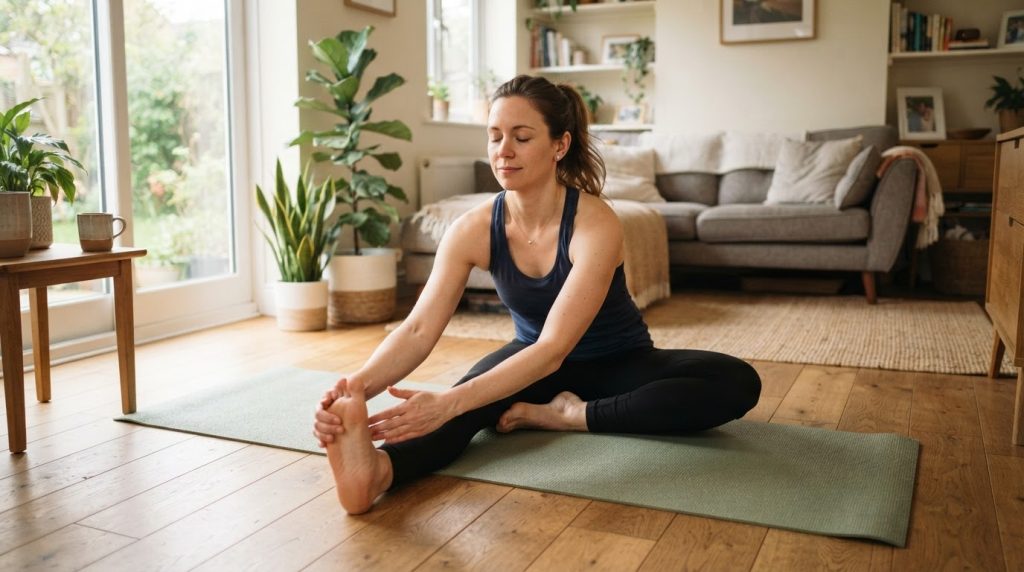
Flexibility tends to decline with age and long hours of sitting. Regular stretching helps keep your joints moving through their full range, can ease stiffness and makes everyday tasks such as bending and reaching easier. You don’t need much time: a few minutes most days is enough to see progress.
Key takeaways
- Stretch at least 2–3 days a week; daily is even better.
- Hold static stretches for 15–30 seconds and repeat 2–4 times.
- Use dynamic (moving) stretches before exercise and static stretches afterward.
- Stretch to mild tension, never to pain.
Types of stretching
- Static stretching: holding a position for a set time. Best after exercise or as a separate session.
- Dynamic stretching: controlled movements such as leg swings and arm circles. Best as a warm-up.
Benefits of stretching
- Improved flexibility and range of motion
- Less stiffness, especially after sitting
- Better posture and ease of everyday movement
- A relaxing break that can help reduce stress
Stretching before exercise has not been shown to reliably prevent injuries or muscle soreness, so a proper warm-up with light activity matters more.
A 10-minute beginner routine
Warm up first with 3–5 minutes of walking or marching on the spot. Then hold each stretch for 20–30 seconds, twice on each side, breathing slowly.
- Neck stretch: gently tilt your ear toward your shoulder.
- Chest opener: clasp your hands behind your back and lift your chest.
- Cross-body shoulder stretch: pull one arm across your chest with the other.
- Standing quad stretch: hold a wall for balance and pull your heel toward your buttock.
- Hamstring stretch: place your heel on a low step, keep the leg straight and hinge forward from the hips.
- Calf stretch: step one foot back, press the heel down and lean toward a wall.
- Hip flexor stretch: kneel on one knee and gently push your hips forward.
- Child’s pose: kneel, sit back on your heels and stretch your arms forward on the floor.
Safety tips
- Don’t bounce; move slowly into each stretch.
- Feel a mild pull, not sharp pain.
- Keep breathing; don’t hold your breath.
- If you have a joint replacement, osteoporosis, a recent injury or back problems, ask a doctor or physiotherapist which stretches are safe.
Combine stretching with regular aerobic activity such as daily walking for a well-rounded routine.
Frequently asked questions
How long does it take to become more flexible?
With regular stretching, many people notice improvement within 3–4 weeks.
Is it better to stretch in the morning or at night?
Either works. Morning stretching eases stiffness; evening stretching can help you relax before bed.
This article is for general information only and is not medical advice. Check with a doctor or physiotherapist before starting a new routine if you have an injury or medical condition.
